
How Many Sets Are in Volleyball? Indoor, Beach, Youth
If you’re a parent new to the sport, one of the first questions you’ll ask at tournaments is how many sets are in volleyball—because it affects everything from warm-ups and energy to how long you’ll be sitting in the stands. The good news: volleyball is very consistent once you know the “best-of” format and how sets are scored.
In this guide, we’ll break down indoor vs. beach rules, explain the rally scoring system, and share the most common youth volleyball rules parents see in clubs and tournaments. We’ll also give you a quick, featured-snippet-friendly answer right up front—then add the practical details (like tie-break sets and match length) so you can follow the action confidently. If you’re in Orange County, Orange County Volleyball is a great place to learn the game and find a program that matches your athlete’s level.
Quick Summary
Indoor volleyball is usually best-of-5 sets (first to 3 wins).
Beach volleyball is usually best-of-3 sets (first to 2 wins).
Most sets use rally scoring and must be won by 2 points.
The final deciding set is a tie-break (often 15 points).
Youth formats can vary by age group and event—always check tournament rules.
Quick Answer: How Many Sets Are in Volleyball?
Most of the time, the answer depends on the version you’re watching:
Indoor volleyball match sets: commonly best-of-5 (the first team to win 3 sets wins the match).
Beach volleyball match sets: commonly best-of-3 (the first team to win 2 sets wins the match).
Youth volleyball rules: often use best-of-3, but some events use timed matches, shortened sets, or different deciding-set rules.
If you want the simplest parent-friendly way to remember it:
Indoor = first to 3 sets. Beach = first to 2 sets. Youth = usually first to 2 sets (but confirm the event format).
Volleyball Scoring System: Rally Scoring Explained
Modern volleyball mostly uses rally scoring, which means:
A point is scored on every rally (not just when the serving team wins the rally).
Sets are typically played to a target score (like 25 or 21).
Teams must win a set by 2 points (for example, 25–23 ends it; 25–24 keeps going).
Why this matters for parents and beginners:
There are fewer “dead stretches” than older scoring systems, so momentum shifts quickly.
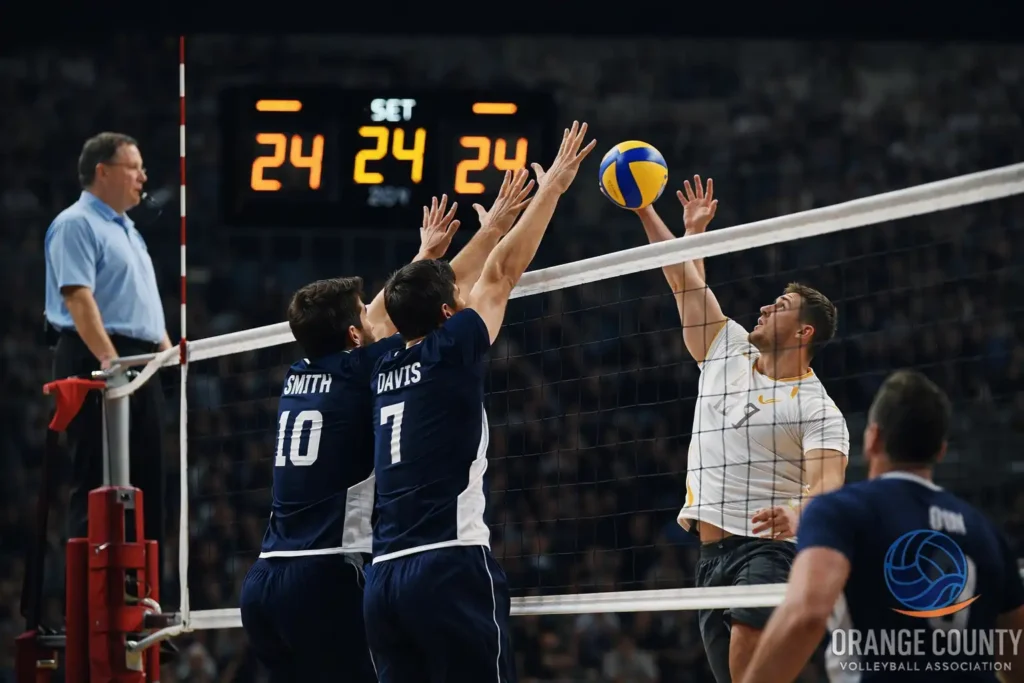
Late-set pressure is real—when you see 24–24 indoors, you’re in “win-by-two” territory and the set can swing fast.
Indoor Volleyball Match Sets and Rules
Indoor volleyball (the most common club, school, and gym version) usually follows this structure:
Standard indoor format (most common)
Match type: Best-of-5
Sets 1–4: to 25 points (win by 2)
Set 5 (tie-break/deciding set): to 15 points (win by 2)
What parents often see in youth tournaments
Many youth events still follow indoor rules, but with tweaks for time and development, such as:
Best-of-3 instead of best-of-5
A cap (example: “first to 25, cap at 27”)
Timed matches (play until the whistle; finish the rally)
Shorter deciding sets (still commonly 15)
If you’re attending a local tournament, check the event details ahead of time—many clubs post formats on their schedules and info pages. You can also keep an eye on local opportunities via Orange County Volleyball Events
Tie-Break: What Happens in the Final Set?
The tie-break is the “last set” when the match is tied.
Indoor tie-break: usually Set 5 to 15, win by 2
Beach tie-break: usually Set 3 to 15, win by 2
Two details parents love to know:
Teams often switch sides at a specific point in the deciding set (rules vary by level), which helps keep conditions fair.
The tie-break is shorter, so every serve receive and unforced error matters more than earlier sets.
Indoor vs Beach Volleyball Rules: What’s Different?
Indoor and beach share the same basic idea (win sets, win match), but they feel very different.
Beach volleyball (typical structure)
Match type: Best-of-3
Sets 1–2: to 21 points (win by 2)
Set 3 (tie-break): to 15 points (win by 2)
Key differences beyond the set count
Players: indoor is usually 6v6; beach is 2v2
Environment: wind, sun, and sand make ball control harder in beach
Strategy: beach demands more all-around skills because each player covers more space
So if you’re comparing indoor vs beach volleyball rules, the set format is just the start—expect the pace and style to change a lot.
Youth Volleyball Rules: Common Variations (Beginner-Friendly)
For beginners and parents, youth volleyball can feel inconsistent because leagues and tournaments adapt rules for learning and safety. Common variations include:
Shorter matches to fit schedules (often best-of-3)
Lower net heights for younger age groups
Allowing a re-serve in very beginner divisions (less common at competitive levels)
Emphasis on development (rotations, playing time expectations, and coaching focus)
If your athlete is brand-new, a program that teaches fundamentals alongside game understanding is a huge advantage. If you’re looking locally, explore Orange County Volleyball Youth Volleyball Programs here: https://orangecountyvolleyball.org/youth-volleyball-programs/
How Long Is a Volleyball Match?
A common parent question is how long is a volleyball match—and the honest answer is: it depends on the format and how close the teams are.
Here are realistic ballpark ranges:
Indoor best-of-5: often 60–120 minutes
Indoor best-of-3 (common in youth): often 45–75 minutes
Beach best-of-3: often 30–60 minutes
What makes matches longer?
Lots of extended deuce points (like 26–24, 30–28)
More timeouts, substitutions, and longer rallies
Tournament logistics (warm-up windows, court changes, delays)
Parent pro tip: if you’re planning your day, look at the match format first (best-of-3 vs best-of-5). That usually tells you more than the scheduled start time.
Parent Cheat Sheet: Following the Score Fast
When you’re new to volleyball, watch for these three clues:
Set score (example: 18–14): tells you who’s ahead in the current set
Sets won (example: 2–1): tells you who’s ahead in the match
Endgame numbers:
Indoor sets usually end at 25 (tie-break ends at 15)
Beach sets usually end at 21 (tie-break ends at 15)
If your athlete wants to level up faster outside team practices, targeted reps make a difference—especially for serving, passing, and confidence under pressure. Consider Private Training here: Private Training in Orange County
FAQ
How many sets are in a volleyball match?
Most indoor matches are best-of-5 (first to 3 sets). Most beach matches are best-of-3 (first to 2 sets). Youth formats vary but often use best-of-3.
How many points are in a volleyball set?
Indoor sets are typically to 25 points (win by 2), with the deciding set to 15. Beach sets are typically to 21 points (win by 2), with the deciding set to 15.
What is rally scoring in volleyball?
Rally scoring means every rally equals a point, regardless of which team served.
What happens if teams tie in sets?
If the match is tied in sets (like 2–2 indoors or 1–1 beach), teams play a tie-break deciding set, usually to 15, win by 2.
Are youth volleyball match rules the same as adult rules?
Often similar, but youth volleyball rules can include best-of-3, shortened sets, caps, or timed formats depending on the league and tournament.
Conclusion: Know the Format, Enjoy the Match
So, how many sets are in volleyball? In most cases, indoor is best-of-5 and beach is best-of-3, with a shorter tie-break set deciding close matches. Once you understand rally scoring and the typical set lengths, the sport becomes much easier—and more fun—to follow.
Looking for youth volleyball programs in Orange County?
👉 Explore Our Youth Volleyball Programs