
Image

Contents hide
1 How to Serve a Volleyball: Overhand to Jump Serve

How to Serve a Volleyball: Overhand to Jump Serve

If you’ve been searching how to serve a volleyball without feeling overwhelmed by conflicting advice, you’re in the right place. A great serve isn’t about “being strong” as much as it’s about repeatable mechanics: a consistent toss, clean contact, and a finish that sends the ball exactly where you want it. Whether you’re a beginner trying to get the ball over the net every time, a coach building reliable servers, or a parent helping your athlete practice at home, this guide will take you from the overhand serve basics all the way to a confident jump serve progression.

At Orange County Volleyball Association (OCVA), we see the same pattern again and again: when athletes master the fundamentals first, they improve faster—and with less frustration. Below, you’ll get clear cues, a “checklist” you can self-coach, and practical serving drills that build consistency before adding power and movement.

Key Takeaways (Quick Summary)

  • Your toss is the steering wheel: fix it first, and everything improves.

  • Think “tall posture + fast hand” instead of “swing harder.”

  • Start with high-percentage targets (deep middle) before going for corners.

  • Use progressive serving drills: accuracy → pressure → power → jump serve.

  • Jump serves work best when your overhand serve is already consistent (and shoulder-friendly).


Who This Guide Is For

This article is written to help everyone involved in youth volleyball:

  • Athletes: Learn what to do (and what to feel) on every rep—from beginner overhand serves to jump serves.

  • Coaches: Get easy progressions, cue words, and drill setups you can plug into practice today.

  • Parents: Understand the basics so you can support skill-building at home—without turning into a “backseat coach.”

If you want a quick companion piece for complete beginners, pair this with beginner volleyball drills to help athletes build ball control alongside serving.


Overhand Serve Fundamentals That Actually Matter

When serving breaks down, it’s usually one of these five pieces—not “lack of power.”

1) Starting stance and balance

A great serve begins still. You want a stance that lets you transfer energy forward without falling sideways.

Checklist:

  • Feet about shoulder-width

  • Non-serving foot slightly forward (comfortable—not forced)

  • Knees soft, ribs down (don’t arch your back)

  • Eyes on the target area, not the net

Coach cue: “Athletic posture—quiet feet.”

2) Grip and ball hold

You don’t “grip” the ball tightly. You support it in your non-serving hand.

  • Hold the ball on your fingertips/palm “platform”

  • Keep it in front of your hitting shoulder, not off to the side

Coach cue: “Ball in front—like you’re presenting it.”

3) The toss (the #1 difference-maker)

Most missed serves come from a messy toss. Your goal is a toss that is:

  • Small (not a skyball)

  • Straight (not drifting left/right)

  • Repeatable (same height, same spot)

Simple rule: Toss the ball just high enough to fully extend your arm at contact—no higher.

Coach cue: “Toss to your hitting window.”

4) Contact point

Clean contact creates predictable flight.

  • Contact the middle-back of the ball for a solid overhand serve

  • Keep your hand firm and open (no “slapping” with floppy fingers)

  • Contact in front of your hitting shoulder with your arm reaching “tall”

Coach cue: “High five the ball—strong hand.”

5) Follow-through and finish

Your follow-through isn’t decoration—it’s direction.

  • Finish with your hand moving through the ball toward your target

  • Let your body come forward naturally (no leaning back)

Coach cue: “Reach and finish to the target.”
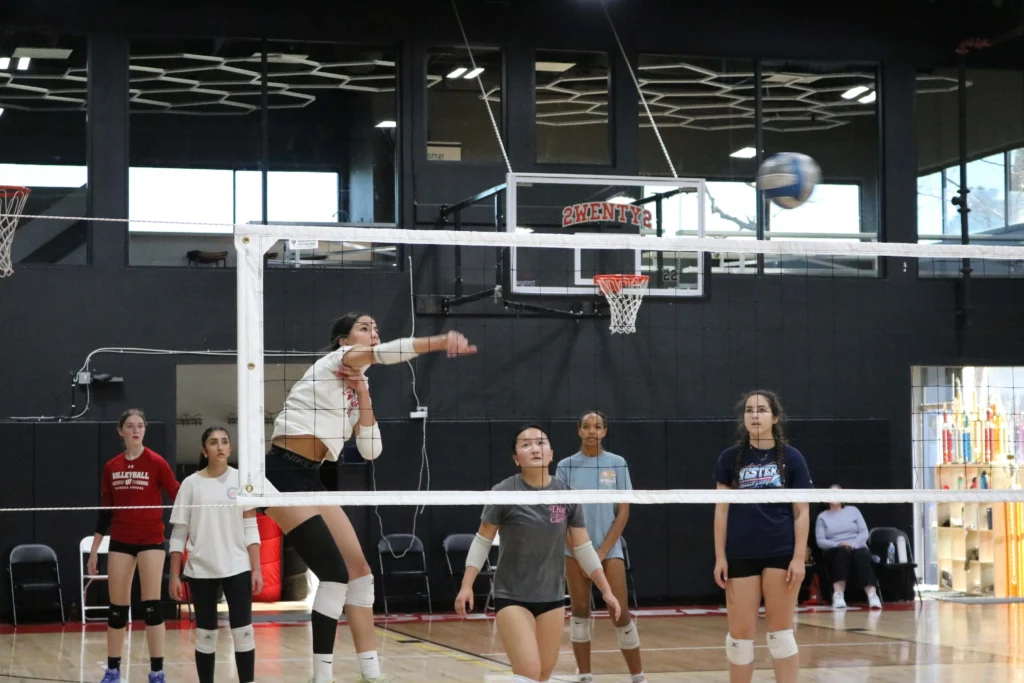
OCVA Academy


Step-by-Step: How to Serve a Volleyball (Overhand Serve)

Use this as a repeatable routine before every serve—especially in matches.

Step 1: Pick a simple target

Start by aiming deep middle (the space between passers). It’s high-percentage and still creates pressure.

Step 2: Set your “serve posture”

  • Tall chest

  • Soft knees

  • Calm breathing

Step 3: Show the ball in your hitting window

Hold the ball in front of your hitting shoulder so your toss is easy to repeat.

Step 4: Toss first, then swing

A common mistake is swinging while tossing. Instead:

  1. Toss

  2. See it

  3. Swing

Step 5: Contact high, in front, with a firm hand

Think “up and through.”

Step 6: Hold your finish for 1 second

This builds consistency and helps you self-correct quickly.

Quick self-check after each rep:

  • Was my toss straight?

  • Did I contact in front?

  • Did the ball go where my finish pointed?

Summer Starts at OCVA

Summer Starts at OCVA

Serving Drills: 12 Options That Build Consistency Fast

You’ll get the best results by using drills that progress from control → accuracy → pressure → power.

Drill 1: Toss-to-Window Reps (no hitting)

Goal: Consistent toss
How: Toss to the same “window” in front of your hitting shoulder; catch it at full extension.
Sets/Reps: 3 x 10 perfect tosses

Drill 2: Wall Contact Tap

Goal: Firm hand, clean contact
How: Stand 6–8 feet from a wall and lightly “high-five” the ball into the wall with serving mechanics.
Sets/Reps: 3 x 15 contacts

Drill 3: Serve-to-Catch Partner

Goal: Accuracy without pressure
How: Partner stands in Zone 6 (deep middle) and catches your serve.
Rule: If they move more than one step, it doesn’t count.
Sets/Reps: 2 rounds of 10 “clean catches”

Drill 4: Short–Deep Ladder

Goal: Depth control
How: Alternate one serve landing short (inside 10-foot line) and one deep (near end line).
Sets/Reps: 3 ladders of 6 serves (short/deep alternating)

Drill 5: Three-Zone Targeting

Goal: Place the ball on command
How: Mark targets (cones or towels) in deep Zones 1, 6, 5.
Score: 2 points hit, 1 point “close,” 0 miss.
Play to: 15 points

Drill 6: “Make 5 In a Row” Challenge

Goal: Mental routine + consistency
How: Same target every time. If you miss, restart at zero.
Time cap: 10 minutes

Drill 7: Pressure Serve After a Sprint

Goal: Game-like fatigue
How: Sprint to end line and back, then serve immediately.
Sets/Reps: 2 x (5 sprints + 5 serves)

Drill 8: Serve Speed Control (70% / 85% / 100%)

Goal: Learn controllable power
How: Hit 3 serves at ~70%, 3 at ~85%, 3 at full speed—same target.
Rule: If accuracy drops, go back a level.

Drill 9: Serve + Defensive Responsibility

Goal: Match realism
How: Serve, then immediately move to your defensive base position.
Sets/Reps: 2 x 8 serves with fast transition

Drill 10: “Miss Long or Miss Net?” Fix-It Set

Goal: Build awareness
How: Track 10 serves:

  • If net: toss likely too low/too far back or contact too low

  • If long: contact may be too under the ball or toss drifting forward
    Adjust one variable only and repeat.

Drill 11: Float Serve Progression (optional add-on)

Goal: Reduce spin for a “float”
How: Firm hand, contact center-back, minimal wrist snap.
Focus: “Quiet wrist, strong palm.”

Drill 12: Jump Serve Approach (dry reps)

Goal: Footwork timing before power
How: Practice approach and toss timing without hitting.
Sets/Reps: 3 x 6 approaches (perfect rhythm)


Fix These Common Serving Mistakes

Here are fast fixes that work for both athletes and coaches.

Mistake: Serving into the net

Likely cause: Toss too low or too far back; contact point too low
Fixes:

  • Toss slightly higher and in front

  • Reach “tall” at contact

  • Finish up and through (not down)

Mistake: Serving long

Likely cause: Toss drifting forward; hitting under the ball; leaning back
Fixes:

  • Toss to the same spot every time (use Drill 1)

  • Contact middle-back, not underneath

  • Keep ribs down—don’t “fall away” from the ball

Mistake: Ball goes sideways

Likely cause: Toss off to the side; shoulder opening early
Fixes:

  • Start with ball in front of hitting shoulder

  • Keep chest more “square” until contact

  • Finish toward your target

Mistake: Weak, slow serves

Likely cause: Slow arm speed, soft hand, no weight transfer
Fixes:

  • Firm hand at contact

  • Faster arm (think “whip” not “push”)

  • Step and transfer weight forward

Mistake: Inconsistent toss under pressure

Likely cause: Rushing routine
Fixes:

  • Add a consistent breath + bounce routine

  • Use “hold finish for 1 second” to slow the moment down


The Float Serve Bridge (Before You Jump Serve)

Many athletes jump too soon (literally) into jump serves. A cleaner path is:

Consistent overhand serve → controlled float serve → jump float → jump topspin

How to get a real float

A float serve isn’t magic; it’s physics. The goal is minimal spin, which lets the ball move unpredictably in the air.

Keys:

  • Firm, flat hand

  • Contact center-back of the ball

  • Little to no wrist snap

  • Finish forward, not around your body

Coach cue: “Palm through the center.”


From Basics to Jump Serve: A Safe Progression That Works

Jump serves are exciting—and effective—but they demand timing, coordination, and shoulder readiness. Here’s the progression that protects confidence and reduces overuse risk:

  1. Overhand serve consistency (8/10 in)

  2. Target serving (deep middle, then corners)

  3. Float control (reduced spin, predictable toss)

  4. Jump float (approach + jump, but controlled contact)

  5. Jump topspin (power + spin, hardest to master)

Minimum standard before jump topspin:
You can consistently place an overhand/float serve to a target and maintain a repeatable toss under pressure.


Jump Serve Technique: Timing, Toss, and Contact

The approach (simple version)

Most youth athletes do well with a 2–3 step approach that feels athletic and repeatable.

Common pattern (right-handed):

  • Left-right-left (or a comfortable 3-step rhythm)

  • The last two steps are your “speed up”

  • Jump forward (not straight up)

The toss (different from overhand)

Jump serve toss is:

  • Slightly higher

  • Slightly more forward

  • Still in your hitting window (don’t chase it)

Rule of thumb: If you’re chasing the toss, it’s too far forward or too far to the side.

Contact: jump float vs jump topspin

  • Jump float: firm hand, center-back contact, minimal wrist

  • Jump topspin: contact slightly above center with a faster “snap” to create topspin (advanced)

Coach cue for jump float: “Jump, freeze the wrist, punch the middle.”
Coach cue for jump topspin: “Fast arm—brush the top.”

Landing and recovery

A safe jump serve lands with control.

  • Land balanced

  • Don’t twist awkwardly

  • Step into the court ready to defend


Practice Plans: 10, 20, and 30 Minutes

10-minute quick serve session (home or before practice)

  1. Toss-to-window: 2 minutes

  2. Serve-to-target (deep middle): 6 minutes

  3. “Make 3 in a row” to finish: 2 minutes

20-minute improvement session

  1. Warm-up (shoulder + core): 4 minutes

  2. Target serves (Zones 1/6/5): 10 minutes

  3. Pressure set (sprint + serve): 4 minutes

  4. Cool-down + notes: 2 minutes

30-minute serious serve builder

  1. Warm-up + bands (if available): 6 minutes

  2. Toss + contact drill (wall or partner): 6 minutes

  3. Targeting game to 15 points: 10 minutes

  4. Jump approach dry reps or jump float reps: 6 minutes

  5. Cool-down + 3 “perfect routine” serves: 2 minutes


Coach & Parent Corner: What to Say (and What to Avoid)

What helps athletes improve faster

Use short, repeatable cues:

  • “Toss to your window.”

  • “High contact.”

  • “Finish to the target.”

  • “Tall posture.”

What usually makes it worse

Overloading athletes with five fixes at once.

Better approach: Pick one correction per set of 5 serves.
Example: “This set is only about toss position.”

For parents navigating the bigger youth volleyball journey—especially tryouts—this guide on volleyball tryout tips is a helpful next read.


When It’s Time to Get Extra Support

If an athlete is “stuck” (for example, they can serve in warmups but not in matches), it usually means they need:

  • A more reliable pre-serve routine

  • A better drill progression

  • Feedback on one key mechanic (often toss or contact)

That’s exactly where structured training helps. If your athlete wants guided development, explore youth volleyball classes designed to build skills step-by-step—serving included. You can also check upcoming events for clinics and training opportunities.


FAQ: Serving Questions Players Ask All the Time

How high should I toss the ball for an overhand serve?

High enough to reach full extension comfortably—usually not “way above your head.” A toss that’s too high is harder to repeat under pressure.

Where should I aim as a beginner?

Deep middle is the best start. It’s safer than corners and still forces passers to communicate.

Should I learn a jump serve right away?

Most athletes benefit from mastering overhand consistency and a basic float first. Jump serves become much easier when your toss and contact are already stable.

How many serves should I practice per day?

Quality matters more than huge volume. 30–60 focused serves with a goal (targets + tracking) is often better than 200 rushed reps.


Conclusion: Master the Overhand, Then Earn the Jump Serve

If you take only one lesson from this guide, let it be this: the best servers aren’t the ones who swing the hardest—they’re the ones who repeat great contact off a consistent toss. Start with a simple target, dial in your toss and finish, and use progressive serving drills to build confidence under pressure. Once your overhand and float mechanics are reliable, the jump serve stops feeling like a gamble and starts feeling like a weapon.

If you want faster progress with real-time corrections and a personalized plan, OCVA can help. Take the next step with private volleyball coaching focused on serving technique, accuracy, and match-ready confidence.

Private Training by Coach Shiari

Flexible weekday and weekend availability

Join OCVA and start your journey in volleyball world today.

Browse OCVA volleyball events in Irvine & Orange County